Acupoints in Tai Chi Qigong — Post 1
Learn how meridians and acupoints guide your energy and deepen your tai chi qigong practice.
Understanding the Role of Acupoints in Tai Chi Qigong
In this series, you’ll learn the key acupoints that support tai chi qigong practice. Acupoints are gateways along the meridians — the pathways that guide the flow of intrinsic lifeforce energy (chi). You don’t need to press or massage these points. In tai chi qigong, you activate them through posture, breath, and yi (intention).
Understanding these points helps you feel alignment, grounding, and the internal pathways that shape tai chi qigong from within.
What Yi Means in Tai Chi Qigong
In tai chi qigong, yi is the mind’s intention — quiet, steady awareness directed into a specific part of the body. It is not forceful concentration and not imagination. Instead, yi is the ability to place your attention so clearly that the body responds.
Beginners experience yi as simple awareness: noticing the crown, the lower back, the pelvic floor, or the soles of the feet. As sensitivity grows, yi becomes the main way you activate acupoints and sense internal pathways.
It helps you feel alignment from the inside — how the spine lengthens, how the pelvis settles, and how weight flows downward through the feet.
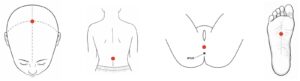
In tai chi qigong, yi is what connects posture, breath, and movement. It guides the flow of chi along the meridians and helps the four key acupoints — baihui, mingmen, huiyin, and yongquan — work together as one vertical axis. Over time, yi becomes the bridge between what you intend and what your body actually does.
How TCM Connects to Tai Chi Qigong
Tai chi qigong did not appear in isolation. It grew out of the same worldview that shaped Traditional Chinese Medicine (TCM). Both are based on the understanding that chi flows through the body along meridians, and that health depends on this flow being smooth, balanced, and responsive.
In TCM, meridians and acupoints are used to influence the body’s internal state—through acupuncture, herbs, movement, breath, and lifestyle. In tai chi qigong, you work with the same meridians and acupoints, but through movement, posture, and intention. Instead of needles, you use alignment, relaxation, and yi to guide the flow of chi.
You do not need to become a TCM practitioner to benefit from this knowledge. What matters for tai chi qigong is understanding that your practice is not just “exercise.” It is a way of working with the same energetic pathways that TCM uses to support health, balance, and resilience.
What Are Meridians?
Meridians are the pathways through which chi circulates in the body. They connect the organs, limbs, and energetic centers into one continuous system. In tai chi qigong, movement, breath, posture, and yi (intention) guide the flow of energy through these pathways.
Like chi itself, meridians are invisible. You cannot see them on an X‑ray, MRI, or scan. No machine can measure them directly, and yet both Traditional Chinese Medicine and tai chi qigong are built on the assumption that they exist.
The proof, in these traditions, comes from experience: changes in sensation, health, balance, and emotional state as you work with these pathways.
If we accept that chi and meridians exist within this framework, then acupoints naturally follow. Acupoints are simply the specific locations along these invisible pathways where the flow of chi can be most easily accessed, influenced, or felt.
What Are Acupoints?
Acupoints are specific locations along the meridians where chi becomes easier to access or influence. Because acupoints are part of the meridian system, they share the same nature: they are invisible, not detectable by scans or instruments, and understood through experience rather than measurement.
Within the framework of tai chi qigong and Traditional Chinese Medicine, acupoints are treated as energetic gateways along these pathways.
Different disciplines work with acupoints in different ways:
- Acupuncture uses needles to stimulate the point.
- Acupressure uses physical pressure or massage.
- Moxibustion warms and activates the point using burning mugwort (often with a ginger base).
- Tai chi qigong uses yi — the mind’s intention — to activate the point internally.
For beginners, gentle touch or acupressure can help make the point easier to locate and feel, especially when sensitivity to chi is still developing.
As your awareness deepens, you no longer need to press the point. You can activate it through posture, breath, and yi alone. Advanced practitioners work almost entirely internally, using intention to open, close, or direct the point without any physical contact.
Why Acupoints Matter in Tai Chi Qigong
Acupoints matter in tai chi qigong because they help you understand how the body organizes itself from the inside. When you know where these gateways are, it becomes easier to sense alignment, balance, and the direction of chi flow. Each point acts as a reference marker along the body’s central pathways.
For tai chi qigong, four points are especially important: baihui, mingmen, huiyin, and yongquan. Together, they form a vertical line from the crown of the head to the soles of the feet. When these points align, the posture naturally settles — the crown lifts, the spine opens, the pelvic floor softens, and the feet connect clearly with the ground.
Acupoints support your practice by:
- giving you internal landmarks for sensing posture
- helping you feel whether the spine is lengthened and centered
- clarifying the vertical axis used in tai chi qigong
- outlining the pathway associated with the microcosmic orbit
Acupoints don’t replace the practice — they illuminate it. They help you feel how posture, alignment, and internal pathways work together as your sensitivity develops.
What This Series Will Cover
This series introduces the four key acupoints that support alignment and internal awareness in tai chi qigong. Each post focuses on two related points so you can learn their location, purpose, and how they help organize the body from within.
You will explore:
- points that support gentle upward lengthening and clear spinal alignment
- points that help the lower back open and the pelvis settle
- points that support grounding and the natural downward flow of weight
- how these four points form a vertical axis used in tai chi qigong
- how this axis relates to the pathway of the microcosmic orbit
Each post will show you where the point is, how to sense it, and how it contributes to posture and internal connection. You do not need to press or massage these points. Simply knowing where they are helps you feel the internal pathways more clearly as your practice develops.
By the end of the series, you will have a simple internal map that supports alignment, grounding, and the natural circulation of chi — one breath, one point, one pathway at a time.
Moving Forward, One Breath at a Time
As you move through this series, take your time with each point. Let the information settle into your body gradually. The four key acupoints — baihui, mingmen, huiyin, and yongquan — form a simple internal map that supports alignment, grounding, and the natural flow of chi.
You don’t need to feel everything right away. Just return to the points gently, and over time the vertical axis and internal pathways will become clearer.
Let each post guide you step by step. Explore each point slowly. Let the ideas settle into your body. And as you do, keep returning to the tai chi qigong you learn here — steady, simple, and grounded. One breath, one movement at a time.
If this speaks to you, stay with the series. Follow each post as it comes. Let the ideas settle into your practice slowly and naturally. With time, these points will help you feel your own energy with more clarity and confidence.
Practice and be well.
You might be interested in:
- Acupoints in Tai Chi Qigong — Post 2 Tai Chi Qigong Alignment Via Baihui & Mingmen Acupoints
- Acupoints in Tai Chi Qigong — Post 3 Completing the Tai Chi Qigong Axis: Huiyin and Yongquan
- Acupoints in Tai Chi Qigong — Post 4 Integration: The Tai Chi Qigong Axis That Reveals Itself