Acupoints in Tai Chi Qigong — Post 2
Finding lightness above and steady support within, opening the path toward meditation in motion.
In tai chi qigong, alignment is shaped from the inside out. Two acupoints play a central role in this internal organization: Baihui (百會) Hundred Convergences at the crown and Mingmen (命門) Gate of Life at the lower back.
These points are often described as gates because they influence how the spine lengthens, how the torso settles, and how chi flows through the body’s central pathways.
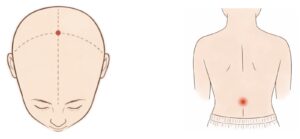
In the previous post, I mentioned that acupoints are gateways along the meridians — places where the intrinsic lifeforce energy becomes easier to access or influence. In tai chi qigong, these points respond through posture, breath, and yi, the quiet intention that helps the body organize itself from within.
Baihui and Mingmen each have many uses in meditation and Traditional Chinese Medicine (TCM). Here, we focus on how these two gates support alignment, ease, and the internal spaciousness that defines meditation in motion.
Understanding them gives beginners a clearer sense of the body’s upper and central structure. This foundation prepares the way for the lower gates — Huiyin (會陰) and Yongquan (永泉) — which will be explored in the next post.
The First Two Gates of the Vertical Axis
Before exploring the lower gates, it helps to understand how the upper and central structure organizes itself. Baihui (百會) and Mingmen (命門) form the upper–core axis of the body, shaping how the spine lifts, opens, and responds from within.
These gates also reflect the yang qualities of the upper body. Baihui relates to clarity and upward spaciousness, while Mingmen is linked with warmth, vitality, and the body’s internal fire. Together, they influence how intrinsic energy circulates through the central pathways and how the torso balances between lightness above and stability below.
Beginning with these two points gives beginners a simple, accessible way to sense the body’s internal organization. Once this upper–core relationship is clear, the lower gates — Huiyin (會陰) and Yongquan (永泉) — naturally make more sense and complete the vertical axis used throughout tai chi qigong.
What Makes a “Gate” in Tai Chi Qigong
In tai chi qigong, certain acupoints play a deeper structural role. These are known as gates (門). A gate is a place where alignment, breath, and awareness naturally gather. It acts like a hinge within the body’s internal architecture, shaping how the spine organizes itself and how the intrinsic chi moves through the central pathways.
When a gate feels open, the surrounding area has a sense of spaciousness and responsiveness. When it feels closed, the body may seem compressed or disconnected from its natural alignment. Understanding this difference helps beginners sense how the body organizes itself from within.
Baihui (百會) and Mingmen (命門) are considered gates because they influence the body’s upper and central structure. Baihui helps the spine lengthen without strain, while Mingmen supports the lower back and the body’s center. Together, they form the upper–core relationship that anchors the vertical axis used throughout tai chi qigong.
Baihui (百會, DU‑20, “Hundred Convergences”) — The Crown Point
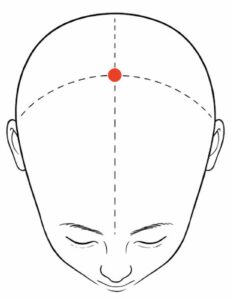
Baihui (百會), often translated as “Hundred Convergences,” sits at the highest point of the crown. Its name reflects the many meridians that meet here, making it one of the most influential points in the body’s upper structure. In tai chi qigong, Baihui helps create a sense of lightness and gentle upward spaciousness along the spine.
Location
You can find Baihui by touching the top of your head and feeling for the highest point along the midline. It sits slightly behind the midpoint between the ears.
Many people notice a natural sensitivity here or a subtle hollow beneath the surface. If you want to explore this point more clearly, you may gently press or massage the area to see how it responds.
Why Baihui Matters
As the upper gate, Baihui connects with Mingmen below to form the upper–core relationship of the vertical axis. When these two points are understood together, the spine feels more integrated from top to bottom. This relationship becomes even clearer when the lower gates — Huiyin (會陰) and Yongquan (永泉) — are added in the next post.
Broader Uses
Beyond tai chi qigong, Baihui is used in meditation, healing practices, and the circulation of chi in the microcosmic orbit (小周天). These broader functions are part of its traditional role, but in this post, its purpose is to help readers understand how the upper structure organizes itself from within.
Mingmen (命門, DU‑4) — The Core Gate
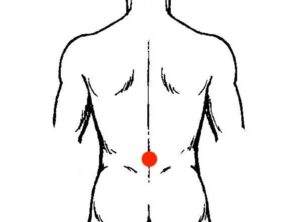
Mingmen (命門), the “Gate of Life,” sits on the midline of the lower back, directly behind the navel. Its name reflects its traditional role as a source of vitality, warmth, and internal support. In tai chi qigong, Mingmen helps you understand how the body organizes its center from within.
Location
You can find Mingmen by placing your hand on the lower back and feeling for the soft area between the second and third lumbar vertebrae. It rests in the natural hollow just above the waistline.
Many people notice warmth, sensitivity, or a gentle fullness here. If you want to explore this point more clearly, you may lightly press or massage the area to sense how it responds.
Why Mingmen Matters
In tai chi qigong, Mingmen influences the body’s internal “opening.” When this point feels clear, the lower back softens, the waist becomes more responsive, and the breath moves with greater ease. This quality is associated with steady warmth, vitality, and the feeling of being supported from the center.
An open Mingmen does not refer to movement or posture adjustments. It describes an internal spaciousness that allows the spine to feel buoyant rather than compressed.
When this area is tense or collapsed, the breath often becomes shallow and the torso feels restricted. When it is open, the body feels more grounded and naturally upright.
How Mingmen Supports the Vertical Axis
As the core gate, Mingmen connects the upward spaciousness of Baihui with the grounding influence of the lower gates. It acts as the central hinge of the vertical axis, helping the upper and lower body communicate as one continuous structure. This relationship becomes even clearer when Huiyin (會陰) and Yongquan (永泉) are introduced in the next post.
Broader Uses
In TCM, Mingmen is linked with the primordial energy (元氣) and the internal Life Fire (命火), often associated with vitality, warmth, and resilience. While these broader functions belong to its traditional role, here its purpose is to help readers understand how the body’s center organizes itself in tai chi qigong.
The Baihui–Mingmen Relationship: The Upper–Core Axis
When Baihui (百會) and Mingmen (命門) are understood together, they form the upper–core axis of the body. This axis gives beginners a simple way to sense how the spine organizes itself from within. It connects the lightness above with the steady support of the center, creating a feeling of uprightness without effort.
At the top, Baihui offers gentle upward spaciousness. At the center, Mingmen provides warmth, stability, and internal support.
When these two gates feel clear, the spine often responds as a single, continuous structure. The breath moves more freely, the torso feels more open, and the body settles into a natural balance between lifting and grounding.
This relationship also explains why these two gates come before the lower ones. Once the upper–core axis is clear, the lower gates — Huiyin (會陰) and Yongquan (永泉) — can be sensed with greater ease. Together, all four points form the vertical line used throughout tai chi qigong.
Why These Two Gates Come Before Huiyin & Yongquan
In tai chi qigong, the body’s internal organization develops from the top down. The upper and central structure must feel clear before the lower gates can be understood. Baihui (百會) and Mingmen (命門) create this foundation by shaping how the spine lifts, opens, and responds from within.
When these two gates are understood, the body gains a sense of vertical orientation. The breath moves with greater ease, and the upper–core axis becomes more recognizable.
This clarity makes it much easier to sense the lower gates—Huiyin (會陰) and Yongquan (永泉) — because the body already has an internal reference for alignment.
Beginning with Baihui and Mingmen helps beginners avoid forcing alignment from the bottom up. Instead, the body feels supported from above and within, allowing grounding and rooting to develop naturally when the lower gates are introduced in the next post.
Exploring These Points for Yourself
You don’t need to perform any tai chi qigong movements to explore these two gates. Simply locating them helps you understand how the body organizes itself from within. This is not a practice session — just a way to become familiar with the points you’ve been reading about.
To explore Baihui (百會), touch the highest point on the crown and notice how the area feels. Many people sense a natural sensitivity or a subtle hollow beneath the surface. You may also notice a gentle upward quality through the top of the head when this point becomes clear.
To explore Mingmen (命門), place your hand on the lower back and feel for the soft area between the lumbar vertebrae. This point often has a warm or responsive quality, especially when the lower back is relaxed. Some people notice a sense of fullness or gentle expansion behind the navel.
You can lightly press or massage either point if you want to feel them more distinctly. As your awareness grows, these points become easier to sense without touch, forming part of the internal map that supports your tai chi qigong practice.
This is how tai chi qigong develops tingjin — internal listening. Not through memorizing theory, but through feeling how your body organizes itself when these points are awake and working together.
From Concept to Embodied Experience
Baihui (百會) and Mingmen (命門) form the upper–core relationship that helps the body organize itself from within. When these two gates feel clear, the spine becomes more continuous, the breath moves with greater ease, and the body gains a natural sense of vertical orientation. This clarity prepares you to recognize the lower gates in the next post.
These points also show that tai chi qigong develops through internal awareness rather than external effort. The body responds from the inside when the gates are awake. The feeling is gentle, spacious, and steady — qualities that define meditation in motion.
If you’d like to explore these sensations more directly, you can try the free sampler lesson on my website. It’s a short, simple way to feel how these points support your practice. To stay updated on new posts and lessons, you’re welcome to revisit anytime; everything is open and self‑paced.
And if you enjoy these posts or some of the free lessons I offer, you’re invited to explore my growing library of e‑courses and experience tai chi qigong for yourself — one breath, one movement at a time.
You might be interested in:
- Acupoints in Tai Chi Qigong — Post 1 Understanding Meridians and Acupoints in Tai Chi Qigong
- Acupoints in Tai Chi Qigong — Post 3 Completing the Tai Chi Qigong Axis: Huiyin and Yongquan
- Acupoints in Tai Chi Qigong — Post 4 Integration: The Tai Chi Qigong Axis That Reveals Itself