Understand how the living plumbline becomes an internal thread of support that reshapes your sense of vertical alignment.
Series: Acupoints in Tai Chi Qigong
In the first post of this series, we explored how meridians, acupoints, and yi (意) shape tai chi qigong from within. We looked at how these gateways help you sense alignment, grounding, and the internal pathways that support meditation in motion.
The next two posts introduced the four gates that form the body’s vertical axis: Baihui (百會) and Mingmen (命門) above, Huiyin (會陰) and Yongquan (湧泉) below.
The four gates are often described as forming a “straight line” through the body, but this line is not an anatomical structure. The spine has natural curves, the pelvis would need to lock into a fixed position to remove those curves, and the four gates still would not sit on a literal geometric axis.
The traditional image of a plumbline does not describe a physical posture; it describes an internal feeling.
When the body relaxes, the spine unwinds, the pelvis settles, and the breath drops lower. The four gates begin to relate to one another in a continuous way—not because they line up visually, but because the body is no longer bracing. The sense of verticality that appears is quiet, responsive, and alive. It is not held. It emerges.
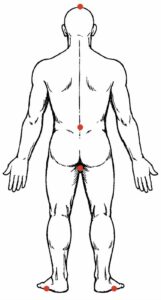
The four gates introduced in the earlier posts are shown below. These points do not form a straight anatomical line. Instead, they mark the upper, central, and lower regions that contribute to the body’s internal organization. Seeing their actual locations clarifies why the vertical axis is sensed from within rather than arranged from without.
Reconnecting the Thread of the Series
One of the most common misunderstandings in tai chi qigong is the idea that alignment must be arranged. Many people try to “stack” the body into a straight line, believing this will help the four gates connect.
But when alignment becomes something to hold, the body tightens. The spine stiffens, the breath becomes shallow, and people try to force the natural curves of the back into shapes the body cannot sustain without effort.
This is where the idea of the plumbline becomes meaningful — not as a posture to hold, but as an internal continuity that appears when the body stops bracing. The four gates become part of a single, responsive axis that supports the body without rigidity and allows movement, breath, and awareness to flow more freely.
Relaxation vs. Posture
One of the most common misunderstandings in tai chi qigong is the idea that alignment must be arranged. Many people try to “stack” the body into a straight line, believing this will help the four gates connect.
But when alignment becomes something to hold, the body tightens. The spine stiffens, the breath becomes shallow, and the natural curves of the back are forced into shapes they cannot sustain without effort.
The traditional image of a plumbline can make this confusion worse. If taken literally, it suggests that Baihui (百會), Mingmen (命門), Huiyin (會陰), and Yongquan (湧泉) should line up on a single vertical plane.
Anatomically, this cannot happen without bracing. The spine’s natural curves, the shape of the pelvis, and the way the legs support the torso all prevent the body from forming a straight column. Trying to force this shape creates the very tension the practice is meant to dissolve.
In tai chi qigong, alignment does not come from arranging the body into a position. It appears when the body releases. As the spine unwinds and the pelvis settles, the four gates begin to relate to one another in a way that feels continuous.
This continuity is not visual. It feels internal and does not depend on symmetry or geometry. It depends on the absence of holding.
Relaxation is what allows the vertical axis to emerge. When the body stops trying to be upright, it becomes upright in a different way — quietly supported from below, gently open above, and connected through the center without effort.
This is why practitioners describe the plumbline as “living.” It is not a posture to maintain. It is a relationship that appears when the body is no longer trying to shape itself.
The Living Plumbline
When the body is no longer trying to hold itself upright, a different kind of verticality appears. It does not come from arranging the bones or lining up the four gates on a straight path.
It comes from the way the body responds when tension drops. As the spine softens and lengthens, the upper, central, and lower gates begin to feel connected in a quiet, continuous way.
Many students imagine the plumbline as a straight line running through all four gates. Anatomically, this is not possible without tension. The spine’s natural curves, the shape of the pelvis, and the way the feet support the body all prevent the gates from lining up on a single vertical plane. The image below shows this clearly.
Understanding How the Plumbline Moves Through the Body
Even in relaxed, natural postures—whether standing upright or bending the knees—the plumbline passes through Baihui (百會) and the general region of Huiyin (會陰), but not through Mingmen (命門) or Yongquan (湧泉).
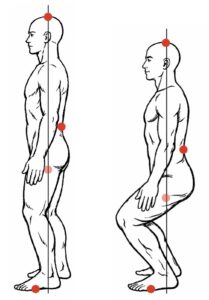
This is why the vertical axis in tai chi qigong cannot be understood as a geometric line. It is a felt continuity that appears when the body releases. The four gates relate to one another internally, even though they do not align visually.
This continuity is not a shape. It is a sensation. Baihui may feel light or open, as though the top of the head is gently spacious. Mingmen may feel warm or responsive, as if the center of the back is breathing.
Huiyin may feel settled, giving the torso a place to rest. Yongquan may feel receptive, as though the ground is meeting the feet rather than the feet pressing downward.
When these qualities are present at the same time, the body feels organized from within. The axis feels steady without being rigid, upright without being held, and aligned without being arranged. This is the living plumbline—the quiet thread that ties the four gates into one continuous experience.
How Integration Changes the Body’s Experience
When the four gates begin to relate to one another as a single continuity, the body’s experience changes in subtle but noticeable ways. The sense of uprightness no longer comes from holding the posture.
It comes from the way the body organizes itself when tension releases. The structure feels supported from below and open above, as though the body is resting into its own natural alignment.
The breath often becomes quieter. Without the effort of arranging the spine or positioning the pelvis, the diaphragm moves more freely and the lower abdomen softens.
This softening is not something you do; it is something that happens when the body is no longer bracing. The breath settles downward, and the torso feels more spacious without any deliberate expansion.
How Integration Changes Balance and Support
Balance also feels different. Instead of trying to stabilize yourself, the ground seems to meet you more clearly. The feet feel broader, the legs feel more connected, and the weight distributes itself without effort.
This is not the heaviness of sinking or the firmness of rooting. It is a quiet steadiness that comes from the body recognizing where its support begins.
Most importantly, movement feels more continuous. When the living plumbline is present, the body responds as a single unit rather than as separate parts.
Shifting weight, turning the waist, or simply standing still all feel more integrated. The internal pathways that once seemed abstract begin to feel natural, as though the body has always known how to organize itself this way.
This is the effect of integration. The four gates no longer function as isolated points to locate or remember. They become part of a single, responsive thread that supports the body from within. The practice feels simpler, quieter, and more coherent—not because you are doing more, but because you are doing less.
Bringing It All Together
The four gates — Baihui (百會), Mingmen (命門), Huiyin (會陰), and Yongquan (湧泉) — were introduced one at a time so their qualities could be felt clearly. Each point offers a different way to sense the body’s internal organization.
When these qualities come together, they form a single thread that supports the body from within. This thread is not a straight line and not a posture to arrange. It is the living plumbline that appears when the body releases.
Understanding the plumbline in this way changes how the practice feels. Instead of trying to align the body to a visual standard, you begin to notice how the body organizes itself when tension drops.
The spine unwinds, the breath settles, and the feet meet the ground more clearly. The four gates relate to one another without effort, and the vertical axis becomes something you sense rather than something you try to create.
This is the heart of tai chi qigong. The practice becomes simpler, quieter, and more coherent. The internal pathways feel more natural, and the body responds with a steadiness that does not depend on holding or arranging.
The living plumbline is not an achievement. It is a relationship — one that becomes clearer each time you return to the practice with ease and attention.
Letting the Plumbline Come Alive in You
Stay updated on the posts I publish regularly and explore the free sampler lesson on my website. Then you can sense for yourself how these ideas take shape in your own body.
And if you find yourself wondering what the full tai chi qigong experience might offer, one of my e‑courses is a natural next step — an invitation to feel the living plumbline directly, one breath, one movement at a time.
You might be interested in:
- Acupoints in Tai Chi Qigong — Post 1 Understanding Meridians and Acupoints in Tai Chi Qigong
- Acupoints in Tai Chi Qigong — Post 2 Tai Chi Qigong Alignment Via Baihui & Mingmen Acupoints
- Acupoints in Tai Chi Qigong — Post 3 Completing the Tai Chi Qigong Axis: Huiyin and Yongquan