Acupoints in Tai Chi Qigong — Post 3
How the lower gates set the rooting foundation and create a sense of grounding, balance and support from within.
In tai chi qigong, the body’s internal map unfolds one gate at a time. In the previous post, we explored Baihui (百會) and Mingmen (命門). These are the upper and central gates that shape the spine’s lift and quiet opening. With those points familiar, we move into the body’s foundation, the lower gates that support everything above.
This post introduces Huiyin (會陰) at the perineum and Yongquan (湧泉), the “Bubbling Spring” on the sole of the foot. These two gates carry the deep yin qualities of earth: settling, receiving, and grounding. They form the body’s root system, the place where awareness sinks and the feeling of stability begins.
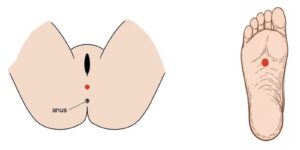
Understanding these gates does not require movement. It begins with noticing how the body responds when attention drifts toward the perineum and the soles. The shift is subtle — a quiet settling, a softening downward, a sense of being held from below. These qualities complete the vertical axis and help beginners sense how the body organizes itself from the ground up.
Why the Lower Gates Matter
The lower gates form the body’s foundation. While Baihui (百會) and Mingmen (命門) help the spine feel lifted and open, the lower gates give that structure somewhere to settle. Huiyin (會陰) and Yongquan (湧泉) carry the deep yin qualities of earth — quiet, steady, receptive — and these qualities shape how the body feels supported from below.
Moreover, these gates act like a root system. When awareness drifts toward the perineum and the soles, the body often responds with a natural sense of settling. The breath feels lower. The weight distributes more evenly. The mind becomes quieter. None of this requires effort; it comes from the body recognizing its own foundation.
In addition, the lower gates also complete the vertical axis introduced in the earlier posts. With the crown and center familiar, adding the perineum and soles helps beginners sense how the body organizes itself. The structure becomes continuous, not separate parts.
Most importantly, these gates help readers understand that grounding in tai chi qigong is not about pushing downward. It is about allowing the body to connect with the earth through Huiyin and Yongquan, letting stability arise from that connection. This is the first hint of rooting – quiet, steady, and receptive.
Huiyin (會陰, REN-1, “Meeting of Yin”) – Perineum Gate
Huiyin (會陰), often translated as “Meeting of Yin,” sits at the base of the body’s internal structure. Its name reflects the way several yin pathways converge in this area, marking a quiet threshold between the torso and the earth.
In tai chi qigong, this gate is recognized as the lowest point of the torso and an important part of the body’s foundation.
Location
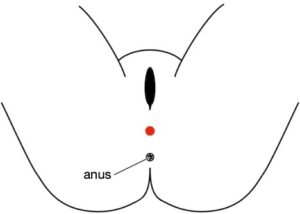
Huiyin rests at the perineum, the soft area between the genitals and the anus. It lies at the base of the pelvic floor, in a region that is more felt than seen. Many people notice a subtle sensitivity or an inward, quiet quality here, especially when the surrounding tissues are relaxed.
Experiential Quality
When awareness includes Huiyin, the body often feels as though it is settling from the inside. The lower abdomen may seem softer, the breath may feel lower and quieter, and the spine can feel as if it is resting into a deeper base.
The overall sensation is one of inward gathering rather than outward effort, as though the body is quietly being held from below.
Why Huiyin Matters
As a result, as the lower gate of the torso, Huiyin gives the body a place to settle, that is, the upper and central structure a place to rest. When this point becomes part of one’s internal map, balance often feels steadier because the structure has a clear base.
This gate also forms the upper part of the body’s root system, linking the torso toward the legs and preparing the pathway that continues through Yongquan (湧泉) on the soles.
Symbolic Role
In traditional theory, Huiyin represents the yin aspect of grounding — quiet, receptive, and inward. It is not about pushing downward, but about allowing the body to feel supported from below.
This distinction helps beginners sense the difference between collapsing and settling, between effort and ease, as they become more familiar with the body’s internal organization.
Yongquan (湧泉, KID‑1) – The Sole Gate
Yongquan (湧泉), the “Bubbling Spring,” is the first point on the Kidney meridian and the lowest point on the body’s energetic map. Its name reflects the image of water rising from a deep source — quiet, steady, and nourishing.
In tai chi qigong, this gate marks the place where the body meets the earth and begins to sense support from below.
Location
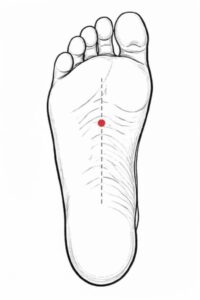
Yongquan sits on the sole of the foot, slightly forward of the mid‑foot, in the natural hollow that appears when the toes curl. It is not on the heel or the ball of the foot, but in the soft center between them. Many people notice a gentle responsiveness here, especially when the foot is relaxed and the weight is evenly distributed.
Experiential Quality
Similarly, when Yongquan is included in awareness, the feet often feel softer and more receptive. The weight may seem to distribute more evenly, and the contact with the ground can feel broader and more stable.
Some people describe a quiet sense of being “received” by the floor, as though the ground is meeting the body rather than the body pressing down.
Why Yongquan Matters
As the external lower gate, Yongquan gives the body a clear point of contact with the ground. When this point becomes part of one’s internal map, the feet often feel more receptive, and the sense of balance becomes steadier without effort.
This gate also completes the lower half of the body’s root system, connecting upward toward Huiyin (會陰) and supporting the entire vertical axis introduced in earlier posts.
Symbolic Role
In traditional theory, Yongquan is known as the body’s primary contact point with the earth — the place where the ground’s stability is first sensed. It is also described as the “drinking point” of chi, a metaphor for how the body receives nourishment and support from below rather than generating it through effort.
This image helps beginners understand that grounding in tai chi qigong is not about pressing downward, but about allowing the feet to become receptive. Through this gate, the body feels supported instead of held up by effort, reflecting the quiet, earth‑oriented yin qualities associated with this point.
How Huiyin and Yongquan Work Together
Huiyin (會陰) and Yongquan (湧泉) form the lower half of the body’s vertical axis. While each gate has its own character, their real value appears when they are understood as a pair. Together, they create the internal pathway that allows the body to feel supported from below, no matter where one is standing.
At the base of the torso, Huiyin gives the structure a place to settle. Its inward, receptive quality helps the spine feel continuous, as though the body is resting into a quiet foundation. This settling is not heavy; it is simply the body recognizing where its base begins.
On the soles, Yongquan provides the point where that foundation meets the earth. Likewise, when this gate is part of one’s awareness, the feet often feel broader and more responsive, and the sense of balance becomes steadier without effort. The body seems to organize itself around a clearer point of contact.
When these two gates are felt together, the lower body behaves as a single, integrated system. The torso feels supported from below, the legs feel connected rather than separate, and the ground seems to meet the body rather than the body pressing downward.
This is the first hint of rooting — a quiet stability that does not depend on strength, size, or the physical surface beneath the feet.
This relationship also completes the vertical axis introduced in the earlier posts. The four acupoints together aid in sensing how the entire body organizes itself. The structure becomes continuous, steady, and naturally aligned, forming the internal map used throughout tai chi qigong.
Bringing It All Together
Huiyin (會陰) and Yongquan (湧泉) complete the lower half of the body’s vertical axis. Together, they give the structure a clear foundation, allowing the upper and central gates to feel supported rather than held up by effort.
When these points are part of one’s internal map, the body often feels steadier, quieter, and more connected from within.
These gates also help beginners understand that grounding in tai chi qigong does not come from pushing downward. Grounding arises from the body recognizing where its base is and how it relates to the earth beneath the feet.
The feeling is simple: a quiet settling through Huiyin, a receptive contact through Yongquan, and a sense of stability that does not depend on strength or force.
With all four gates — Baihui (百會), Mingmen (命門), Huiyin (會陰), and Yongquan (湧泉) — the body gains a clear sense of vertical organization. The spine feels more continuous, the breath moves with greater ease, and the structure becomes more responsive. This internal clarity is what allows tai chi qigong to feel grounded and spacious at the same time.
These points also remind readers that awareness, not effort, shapes the practice. When readers understand the gates, the body responds from within. The feeling is steady, receptive, and naturally aligned — qualities that define meditation in motion.
A Foundation You Can Feel
With Huiyin (會陰) and Yongquan (湧泉), the body gains a foundation that feels truly rooted rather than imagined. These gates show how stability arises from quiet contact with the earth, not from holding or effort. When the lower body feels supported, the rest of the structure responds with ease and the breath settles naturally.
From here, these qualities prepare the way for the next post, where all four gates come together through the idea of the “living plumbline.”
Instead of a posture to arrange, the plumbline is a feeling of natural alignment that appears when the body is relaxed, connected, and supported from top to bottom. It is the thread that ties the entire vertical axis into one continuous experience.
Feel free to explore these ideas more deeply by visiting the site more often. New posts and lessons are added regularly, and everything is open and self‑paced so you can explore at your own rhythm.
And if you enjoy these writings or the free lessons available, you’re invited to explore my growing library of e‑courses and experience tai chi qigong for yourself — one breath, one movement at a time.
You might be interested in:
- Acupoints in Tai Chi Qigong — Post 1 Understanding Meridians and Acupoints in Tai Chi Qigong
- Acupoints in Tai Chi Qigong — Post 2 Tai Chi Qigong Alignment Via Baihui & Mingmen Acupoints
- Acupoints in Tai Chi Qigong — Post 4 Integration: The Tai Chi Qigong Axis That Reveals Itself