Why Shougong Isn’t Universal. How Different Closings Vary Based on the Practice, the Teacher, and Your Own Body.
Most people learn shougong as if it were a single, universal routine — a tidy way to “close” a tai chi qigong session. But shougong isn’t the same everywhere. Some practices have a built‑in closing movement — and these movements can vary — while others rely on a separate sequence.
This can feel confusing. Why aren’t we all doing the same thing? Because shougong isn’t a fixed ritual — it’s a principle. And that principle can be expressed in many ways depending on the purpose of the practice, the needs of the body, and the philosophy of the teacher.
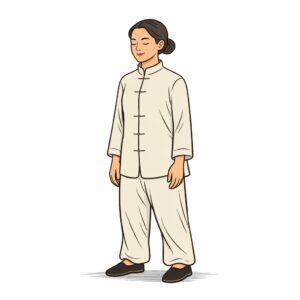
What Shougong Actually Means (Beyond the Movements)
Put succinctly, the word shougong doesn’t point to any particular sequence. It simply means “closing the work.”
At its heart, shougong is about giving your body and mind a moment to settle before you return to regular life. Whether you’re doing tai chi, qigong, standing meditation, or breathwork, the purpose is the same: finish gently, not abruptly.
Hence, the principle is universal, but the expression is not. Once you understand that, the variations stop feeling contradictory and start making perfect sense.
Why Different Lineages Use Different Shougong
Once you stop thinking of shougong as “one fixed routine,” it becomes much easier to understand why different teachers close their practices in different ways.
First, the purpose of the practice shapes the closing.
While a martial tai chi lineage might end with something grounding and alert, in contrast, a wellness‑focused qigong class might choose something softer. Likewise, medical qigong may use a more specific closing to support certain organ systems. The intention behind the practice naturally influences how it’s wrapped up.
Second, different traditions use different energetic frameworks.
Some emphasize gathering into the lower dantian, whereas others focus on whole‑body integration or balancing up and down, inside and outside. In one system, placing the hands on the lower dantian is essential; yet in another, a moment of stillness is enough.
Finally, teacher interpretation plays a role.
Some teachers simplify shougong for beginners so the closing feels accessible. Others preserve a longer sequence because it carries meaning for them. Consequently, no single version becomes “correct” — each reflects the lineage, priorities, and personality of the instructor.
Taken together, these differences show that the variety in shougong isn’t a contradiction. It’s a sign of how adaptable the principle is — and how many ways there are to finish a practice with intention.
Why Shougong Isn’t Always Universal Across Practices
Once you start looking across different Tai Chi and Qigong traditions, it becomes clear that shougong doesn’t always show up in the same way. However, the variations make sense once you look closer.
To begin with, not all practices need the same kind of closing.
For instance, a long, slow qigong session might benefit from a grounding finish, whereas a short standing meditation may only need a quiet moment of stillness. As a result, the closing naturally adapts to the type of practice you’re doing.
Additionally, some practices already contain their own built‑in closing.
Certain tai chi forms end with a natural settling movement, so adding a separate shougong can feel redundant. Likewise, some meditative practices conclude with a soft return to awareness, which already serves the purpose of closing.
And of course, cultural and teaching styles play a role too.
Some teachers emphasize ritual and tradition, while others prefer a more streamlined, practical approach. Consequently, one class might end with a familiar three‑step sequence, whereas another might simply pause, breathe, and bow.
Altogether, these differences show that shougong isn’t meant to be a one‑size‑fits‑all ritual. Instead, it’s a flexible principle that adapts to the practice, the moment, and the person leading it.
How to Know Which Shougong to Use
By the time you’ve seen a few different versions of shougong, it’s natural to wonder which one you’re “supposed” to do. Fortunately, the answer is simple: choose a closing that fits the practice you just finished — and the way your body feels in that moment.
- Match the closing to the type of practice.
- Pay attention to how your body feels.
- Remember that consistency matters more than the exact method.
All in all, choosing a shougong isn’t about finding the “correct” one — it’s about finding the one that helps you finish your practice with clarity and ease.
Why a Simple, Gentle Shougong Works Across Many Styles
By now, it’s clear that shougong can look very different depending on the teacher, the lineage, and the purpose of the practice. Even so, simple, gentle closings tend to work well across tai chi, qigong, standing meditation, and breathwork. In many ways, a straightforward approach strikes a balance that feels natural no matter what came before it.
- A neutral closing fits across traditions. A simple, non‑symbolic approach avoids anything that might feel exclusive. Therefore, it works whether someone is practicing tai chi for wellness, exploring qigong for chronic pain support, or using mindful movement to unwind.
- A neutral closing fits across traditions. A simple, non‑symbolic approach avoids anything that might feel exclusive. Therefore, it works whether someone is practicing tai chi for wellness, exploring qigong for chronic pain support, or using mindful movement to unwind.
- Gentle gestures support the body. Placing the hands on the lower dantian helps settle the attention, rubbing the hands warms the circulation, and massaging the face refreshes the senses. Together, these gestures help the nervous system shift from “practice mode” back into everyday life.
Altogether, this is why simple, grounding closings show up in so many different traditions. They honor the principle of finishing with intention, without locking anyone into a specific lineage or philosophy.
Finishing Your Practice, One Breath at a Time
After seeing how many versions of shougong exist, it’s easy to wonder whether you’re supposed to follow one specific method. But really, the heart of shougong has never been about memorizing a particular sequence. Indeed, it’s about giving yourself a moment to finish your practice with intention.
Some days, that might be a grounding pause with your hands on the lower dantian. On other days, it might be a gentle face massage or a quiet breath. And occasionally, the practice itself already provides a natural closing.
What matters most is that you don’t rush away the moment you stop moving. A soft, mindful ending helps your body integrate the benefits of your practice and supports a smoother transition back into your day.
In the end, shougong is less about the technique and more about the intention behind it. When you close your practice with care, the whole session feels more complete — no matter which version you choose. And as always, the spirit of Tai Chi Qigong remains the same: one breath, one movement at a time.