Fang Song Frees Chi Energy, Opens the Joints, Creates Rooted Strength, and Channels the Quiet Power that Deepens Tai Chi Qigong Practice
Many people come to tai chi qigong because they want less tension in their bodies and more ease in their lives. A core principle that supports this shift is fang song, often translated as “hanging loose.” This simple idea guides your body to soften, your mind to settle, and your chi to flow with less effort. As you explore this principle, you begin to sense how relaxation becomes strength and how softness becomes stability. Even better, fang song offers a practical path toward comfort, clarity, and gentle healing.
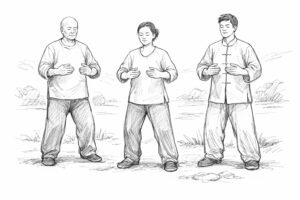
What Fang Song (放鬆) Really Means
Many people translate fang song as “hang loose,” but the literal meaning is “let loose.” This idea points to a gentle release in both body and mind. It also points to a softening that allows your chi to move with ease.
However, “hang loose” helps English readers understand the feeling behind the practice. It suggests a relaxed, suspended quality. It also hints at ease without collapse. Because of this, the phrase works well as a figurative guide.
Even so, fang song does not mean going limp. Instead, it means soft strength. First of all your joints stay open. Moreover, your breath stays calm. And your body becomes rooted and stable. As you explore this quality, you sense how softness supports balance and clarity. You also discover how letting go helps your intrinsic energy flow without strain.
Why Fang Song (放鬆) Frees Your Chi
Fang song helps your chi move without strain. As a result, your intrinsic energy flows with less effort. Because of this, the energy circulation supports healing, spiritual harmony, and inner peace. In addition, it strengthens your tai chi qigong practice in both wellness and martial skill.
Even so, many people hold tension without realizing it. For this reason, they struggle to release their chi fully. My master learned this truth through strict training with his master. The grandmaster often left his three pupils to practice loosening exercises for months.
When he finally returned, he would test their song. He would quietly approach them from behind them and then push them suddenly with his intrinsic energy. If he felt even a hint of resistance, he knew they had not mastered song. Then they had to continue training. Only when a pupil offered no resistance did he begin to teach them the tai chi form. My master was fortunately very gifted and reached this level in six months.
How Fang Song Transforms Body and Chi
I later witnessed a similar transformation in a close friend I coached. He was a retired physician — respected, well-liked and with a wonderful sense of humour — yet he carried a quiet sense of insecurity. Whenever I observed his tai chi form, he would become nervous and tense. His shoulders lifted. His breath tightened. Consequently his intrinsic energy would become inhibited.
To address this, I kept things simple. Instead of correcting his whole form, I asked him to place his hand on a flat surface. I told him to look at it and relax only that hand. Thus by narrowing his focus it helped him practice tingjing (聽勁), the skill of mentally listening within. Once he felt the hand soften, he extended that feeling to his arm. Then, to his shoulder, before going to the less dominant hand. Eventually, he was able to gradually relax his whole body.
And then the real change appeared.
Accordingly, his tension dissolved, his chi began to circulate. His posture didn’t just soften — it settled. Likewise, his stance became naturally rooted, as if the ground itself was supporting him. Additionally, his face exuded a subtle glow, the unmistakable brightness that appears when chi flows freely and unobstructed.
What surprised me was how others responded. Even though they couldn’t see the energy the way I could, they were unconsciously drawn to him. During jinggong meditation, people would drift toward him and choose to sit beside him without knowing why. They felt the steadiness, the warmth, the presence.
This is the end result of fang song. Softness is not collapse. It is the gateway to energy circulation, rootedness and stability, and quiet power.
Simple Ways to Practice Fang Song Every Day
Fang song is easiest to explore through small, everyday movements. You don’t need a long session to begin. Instead, you can start by noticing where your body tightens and letting those areas “hang loose” for a few breaths.
For many people, the shoulders are the first place stress appears. When the shoulders lift, the neck tightens and the chest becomes restricted. A few minutes of loosening can make a noticeable difference. Feel free to download a simple neck‑and‑shoulder Song Jian Gong sampler that guides you through these gentle releases so your upper body can relax and your intrinsic energy can circulate more freely.
Another companion sampler featuring the Shuai Jiao swinging exercises is also available to download. The gentle, rhythmic movements help the body let go of tension, making them ideal for beginners and for anyone who wants to feel more relaxed during the day.
I also have a set of five Song Gong loosening tai chi qigong exercises coming soon. These are the exact same exercises my master learned and mastered after several months of dedicated practice. They can be used for wellness, to reduce stress, inasmuch as they were initially used in martial arts training. Each one helps the body soften so your chi can move with less effort.
These simple practices show that fang song is not abstract. It is something you can feel in your body, even in a few minutes.
Moving Forward in Your Tai Chi Qigong Journey
If this introduction to fang song has sparked something for you, you’re welcome to keep exploring. As you return to my website, you’ll find new blog posts that continue to unfold how tai chi qigong can support ease, heart health, grounding, energy, healing, and circulation in everyday life. In this way, you can stay updated and follow along at whatever pace feels natural.
As you explore these resources, you may find yourself drawn to different starting points. Some people begin with loosening work, while others feel drawn to energy‑building or heart‑focused practices. Ultimately, there is no fixed order. What matters is finding the practice that meets you where you are.
You’ll also notice that my library of e‑courses is still in its early stages. At the moment, you’ll find foundational practices such as the basic Horse Stance and Bow Stance, Dantian Breathing Abridged Edition, as well the full Dantian Breathing Course, not to mention Vibrating Palms Qigong. You’ll also find heart-health qigong, and the bridging Serenity Breath Course. Over time, this library will expand to include energy‑building routines, acupressure for pain, organ‑focused qigong, tai chi walking, cloud hands, and a full series of Song Gong exercises, in short a growing list of e-courses that will go far beyond “hanging loose”.
My intention is to create a long‑term resource you can return to again and again as your tai chi qigong journey deepens.
And throughout your journey, remember this: progress in tai chi qigong doesn’t come from pushing harder. It comes from showing up gently, consistently, one breath, one movement at a time.
You might be interested in:
- Song Gong: The Foundation for Deeper Practice
- Free sampler course Shuai Jiao Course
- Free sampler course Song Jian Gong
- Five Song Gong Exercise Foundational Course