Aligning with TCM — Post 6b
Balance chi, jing, and shen with tai chi qigong — TCM-based exercises that calm the mind, regulate emotions, and restore inner harmony.
Welcome back to our exploration of how tai chi qigong aligns with Traditional Chinese Medicine (TCM) principles. In Part 1, we examined the TCM view of stress and emotions.
Specifically, we looked at how tai chi qigong’s integrated approach helps restore harmony through regulating breath, smoothing Liver Chi, strengthening Heart-Shen, and balancing Yin and Yang.
Specific Qigong Exercises for Emotional Regulation
Certain Tai Chi Qigong exercises are particularly effective for emotional regulation, each working with specific aspects of our energetic system.
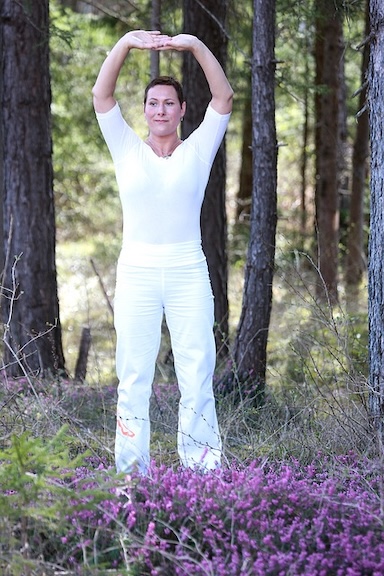
“Supporting the Heavens,” 托天势, for instance, involves raising the arms slowly while inhaling, then lowering them while exhaling. This fundamental movement opens the Lung meridian.
TCM associates this meridian with letting go of grief and sadness. The expansive chest opening creates space for emotional release, while the upward movement symbolizes lifting away heavy emotions.
“Separating Heaven and Earth,” 分開天地 involves one hand pushing up while the other presses down, thus balancing the ascending and descending energies in the body. Consequently, it regulates the Spleen-Stomach axis that governs worry and overthinking. It promots emotional stability in times of uncertainty.
“Five Element Play,” 五行功 works systematically through movements that correspond to the Five Elements (Wood, Fire, Earth, Metal, Water). Importantly, each element relates to specific emotions and organs. By moving through all elements, practitioners achieve emotional balance by addressing the entire spectrum of emotional experiences.
“Calming the Heart and Quieting the Spirit” 安心静神 involves gentle patting or tapping along the Heart meridian. Afterward, place palms over the heart center with focused breathing. In TCM, this directly soothes the Shen (spirit) housed in the Heart and is particularly effective for anxiety and emotional overwhelm.
These exercises fall under the general categories of “regulating the heart/mind qigong,” 調心功 and “regulating the spirit (調神 ).” They are essential aspects of qigong practice alongside “regulating the body”(調息), and “regulating the breath,” (調身).
The Physiological Basis in TCM Terms
Regulating the Three Treasures
To understand the physiological basis, it is helpful to note that tai chi qigong works holistically with the Three Treasures — Jing (essence), Chi (energy), and Shen (spirit) — which are the fundamental energetic substances in TCM.
Regarding the first Treasure, Nourishing and Preserving Jing (Essence) occurs through slow, gentle movements. These actions help conserve rather than deplete our constitutional energy. Attention to the Lower Dantian and the cultivation of song (relaxed alertness) strengthen the Kidneys’ ability to store and preserve Jing.
Furthermore, the meditative aspects reduce stress hormones. By doing so, they prevent depletion of Jing over time, thereby maintaining our foundational vitality.
Cultivating and Circulating Chi (Vital Energy) occurs through the coordination of breath and movement. The slow, deep breathing creates “post-natal Chi” while the gentle movements distribute it throughout the meridian system. Specific movement patterns stimulate particular meridians. This creates a pumping effect that prevents stagnation and allows renewed flow where blockages once existed.
Refining and Calming Shen (Spirit) is achieved through the meditative aspects that create “tranquil awareness,” 静中覺. Finally, rhythmic, bilateral movements harmonize the brain hemispheres. This creates coherence that balances the Fire element associated with the Heart and Shen. Ultimately, this harmony encourages Shen to flourish. It then expresses itself through clear thinking and balanced emotions.
Finally, in the last part of this series, we’ll explore how tai chi qigong creates lasting harmony in your daily life by balancing internal organs and integrating mind, body, and spirit. Don’t miss these insights — visit often for updates and be sure to register for my forthcoming e-courses to deepen your practice and transform your wellbeing one breath, one movement at a time.
You might be interested in:
- What is Chi?
- Aligning with TCM — Post 1 How Tai Chi Qigong Aligns with TCM: Promoting Chi Circulation
- Aligning with TCM — Post 2 Tai Chi Qigong: Balancing Yin and Yang
- Aligning with TCM — Post 3 Unveiling the Five Elements: How Tai Chi Qigong Embodies TCM Principles
- Aligning with TCM — Post 4 Tai Chi Qigong: TCM Meridian & Organ Health
- Aligning with TCM — Post 5 Wei Chi: Strengthening Defence Through Tai Chi Qigong
- Aligning with TCM — Post 6a How Tai Chi Qigong Reduces Stress & Regulates Emotions Part 1
- Aligning with TCM — Post 6c How Tai Chi Qigong Reduces Stress & Regulates Emotions Part 3
- What Is Chi? One Breath, One Movement Revisited
- Song Gong: The Foundation for Deeper Practice
- Tai Chi Qigong for Relaxation: A Guide to Letting Go
- Free sampler course Shuai Jiao Course
- Free sampler course Song Jian Gong
- Five Song Gong Exercise Foundational Course
- Wild Goose Qigong for Heart Health