Shamanic daoyin exercises served as Neolithic precursors to contemporary qigong. These movements were originally used for healing and divination. According to Chinese tradition, qigong has existed since Huang Di (the Yellow Emperor) ruled China over four thousand years ago.
Historians often describe this period as China’s “Golden Age,” a veritable Asian Atlantis. Huang Di was an enlightened ruler who excelled in martial arts, herbalism, and healing. Legend says he and his physician created the Huang Di Nei Jing (Yellow Emperor’s Classic of Internal Medicine), which established the foundation of Chinese medicine.
A Legacy of Invention
Huang Di represents the epitome of Chinese culture. He is credited with many inventions:
- The wheel, ships, and carts.
- Music and money.
- Bricks and astronomy.
While his wife taught the Chinese to weave silk, most stories about the Emperor himself remain legendary. Very little is known about this shamanic period because the writings referencing it were published much later. However, evidence suggests people of this era treated ailments with stone needles and cultivated health through shamanic daoyin exercises.
Shamanic Dances & Stone Probes for Healing
The 1980s discovery of a Neolithic vessel in Northwest China provides physical evidence of qigong used in shamanic rituals and healing. The vessel depicts a wuxi (priest-shaman) performing meditative and gymnastic postures to reach an ecstatic, trance-like state.
Archaeologists have also found artifacts from the Shang Dynasty, such as the Jia Gu Wen (Oracle Bone Scripture). These tortoise shell inscriptions consist of over 160,000 pieces and represent the earliest examples of Chinese writing. While most of these inscriptions are religious or shamanic, 18th-century B.C.E. Shang bones testify to an ancient practice: stimulating “acupuncture reflexes” to balance the flow of chi energy.
The Evolution of Tools
Ancient practitioners understood that sharp tools stimulated chi more effectively than fingers alone. They used stone probes called bian shi to stimulate specific cavities or points on energy channels. This process readjusted energy circulation and relieved pain.
While legends describe shamanic tribes imitating animal movements to fight ailments like rheumatism and arthritis, this tradition isn’t unique to China. Many indigenous cultures worldwide share a history of communal shamanic healing dances. However, the Chinese tradition is unique because these exercises have evolved and remained in continuous use from the dawn of civilization to the present day.
Further Evolution of Daoyin Exercises
The Yi Jing (Book of Changes) is another vital reference for this history. Some historians date this text back to 2400 B.C.E., while others suggest it was written before 1122 B.C.E.. Multiple authors likely contributed to the book over several historical periods.
Significantly, the Yi Jing integrates shamanistic beliefs with the study of chi and the three natural powers: Tian (Heaven), Di (Earth), and Ren (Man). By studying the relationship between these three energies, the ancient Chinese could predict natural events. They represented these forces using eight trigrams, which combined into sixty-four hexagrams to reflect all variations of nature.
Refining the Practice
Understanding these relationships was the first step in developing qigong. As practitioners learned more about the origin and flow of vital energy, the practice evolved from simple shamanic dances into specific methods for breathing, movement, and concentration. These daoyin exercises aimed to cure ailments, build stamina, and increase longevity.
Records on bamboo and bronze from the Zhou Dynasty (1100 B.C.E. to 221 B.C.E.) describe detailed breathing exercises. By this point, qigong included theories on nourishing the San Bao (Three Treasures):
- Chi (vital energy)
- Jing (life essence)
- Shen (spirit)
Early Development of Chinese Medicine
This era saw the rapid growth of the principles that define traditional Chinese medicine. These include Yin-Yang theory, the Five Elements, and various diagnostic tools. Consequently, physicians began mapping the channels where chi flows to establish laws for energy movement.
Between 221 B.C.E. and 220 C.E., during the Qin and Han Dynasties, several medical texts discussed using breathing techniques to promote chi circulation. Specifically, notable works and figures from this period include:
- The Nan Jing (Classic on Disorders): Written by the physician Bian Que, this book prescribed breathing to improve circulation.
- The Xing Qi Ming (Circulating Chi Inscription): This text provides evidence of meditative daoyin practices dating back to the Warring States Period.
- The Han Shu Yi Wen Zhi (The Han Book of Arts and Scholarship): This work described four distinct methods of shamanic daoyin training.
Philosophical and Clinical Milestones
Furthermore, the Taoist philosopher Zhuang Zi confirmed that ancient people used deep breathing to circulate chi. Similarly, Lao Zi described techniques in the Dao De Jing (The Virtue of the Way) for merging with nature and prolonging life.
Simultaneously, medical skills continued to advance through the Qin and Han Dynasties as the dissection of bodies helped physicians better understand human anatomy and energy channels.
Daoyin: The Predecessor of Modern Qigong
In 3 C.E., the famous physician Hua Tuo used acupuncture for surgical anesthesia. He subsequently taught the Taoist Juan Ju daoyin methods and created his own system called Wu Qin Xi (Five Animal Play), which remains popular today.
In addition to treating arthritis and rheumatism, Hua Tuo used these exercises for digestive and circulation problems. Another scholar, Zhang Zhong-Jing, also contributed to the field. His book, Ji Gui Yao Lue (Prescriptions From the Golden Chamber), teaches chi optimization through daoyin breathing and gymnastics.
The Ma Wang Dui Discoveries
In 1984, archaeologists unearthed significant shamanic artifacts at the Han Dynastic Ma Wang Dui Tombs in Changsha. These findings include:
- The Que Gu Shi Qi Pian (Abstaining From Cereal and Consuming Chi): A silk book that teaches fasting, herbs, and breathing exercises.
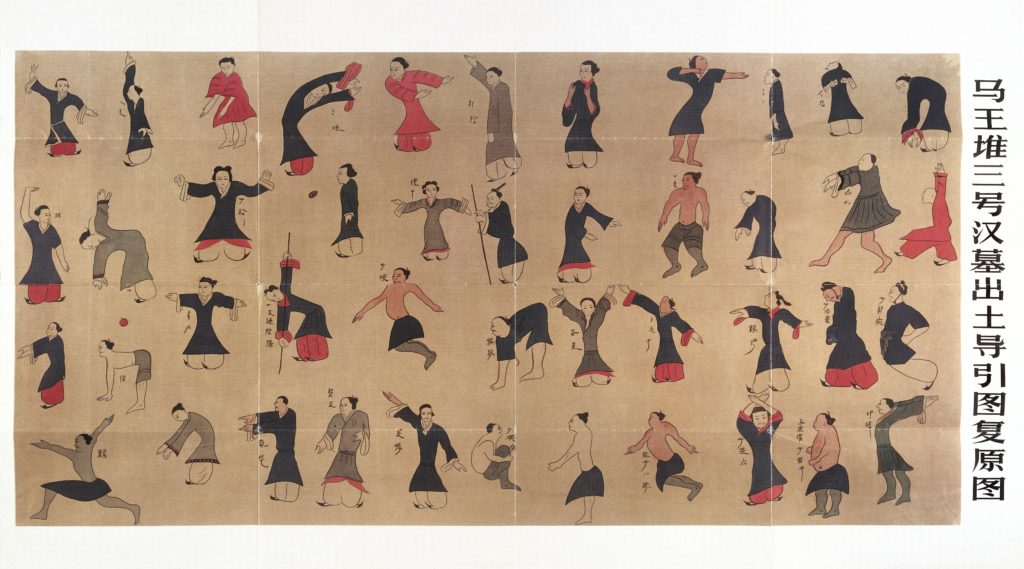
- The Daoyin Tu (Daoyin Gymnastics Chart): A silk painting from 168 B.C.E. featuring 44 color illustrations of daoyin postures.
- Inclusive Practice: The figures include men, women, peasants, and nobility of all ages, suggesting these exercises were available to all social classes.
- The Daoyin Yin Shu (Bamboo Strip Book): A manuscript from 186 B.C.E. outlining over 100 sets of exercises for longevity, prevention, and curing disease.
In short, daoyin evolved from shamanic healing dances. These gymnastic exercises, combined with breathing and concentration, became the practice we now know as qigong.