Mindfulness & Meditation — Post 11
How This Gentle Practice Adapts to All Ages,
Fitness, Health, Ability, Duration, and Space
In many ways, tai chi qigong has a way of meeting each of us exactly where we are. Rather, there’s no pressure to match a shape or pace. Just a gentle space where breath and movement soften the edges of the day.
Often, many of us come to this practice with different stories in our bodies. Some feel strong and steady. Others move with pain, stiffness, or uncertainty. Yet something beautiful happens when we all begin together. Thus, each person finds a rhythm that feels natural, and the practice quietly adapts to every need.
In those shared moments, tai chi qigong is not exclusive, nor is it hierarchical or performance based. It’s actually inherently adaptable. It becomes clear that accessibility isn’t a feature of tai chi qigong. It’s the foundation. The slow movement creates a gentle doorway anyone can step through, inviting ease, curiosity, and a sense of belonging.
Accessibility That Welcomes Every Body
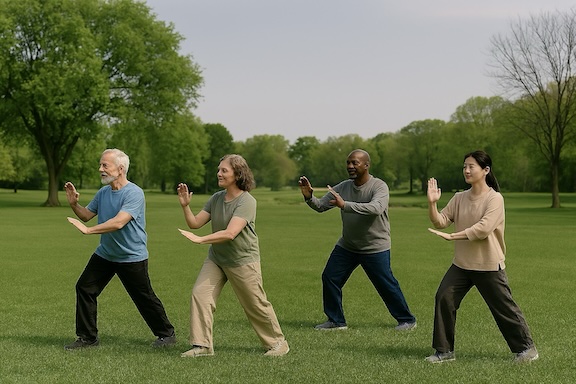
In many ways, tai chi qigong has a way of meeting each of us exactly where we are. Rather, there’s no pressure to match a shape or pace. Just a gentle space where breath and movement soften the edges of the day.
Often, many of us come to this practice with different stories in our bodies. Some feel strong and steady. Others move with pain, stiffness, or uncertainty. Yet something beautiful happens when we all begin together. Thus, each person finds a rhythm that feels natural, and the practice quietly adapts to every need.
In those shared moments, tai chi qigong is not exclusive, nor is it hierarchical or performance based. It’s actually inherently adaptable. It becomes clear that accessibility isn’t a feature of tai chi qigong.
It’s the foundation. The slow movement creates a gentle doorway anyone can step through, inviting ease, curiosity, and a sense of belonging.
Adaptability for Every Ability
One of the quiet strengths of tai chi qigong is how easily it adapts to each person’s individual needs. In reality, the movements never demand more than your body can offer. They simply open a path you can follow at your own pace.
For instance, some days we feel steady and full of energy. Other days we move with stiffness, fatigue, or pain. Therefore, the practice shifts with us. It can be bold and spacious or small and gentle. Both ways carry the same depth.
Sometimes, I’ve seen people with strong athletic bodies move beside people who rely on chairs, walkers, or careful steps. Each one found a version of the movement that felt safe and nourishing. That is the heart of adaptability. The practice bends so we don’t have to.
Consequently, when we allow ourselves to move in the way our body needs, something softens inside. From there, we stop trying to fit into shapes. We start listening instead. And that listening becomes its own kind of healing.
Flexible in Time and Energy
Often, one of the quiet gifts of tai chi qigong is how easily it fits into a real life. The practice can be as short as a few slow breaths. Amazingly, just two or three minutes can shift the whole tone of a day.
Similarly, when we have more time, the practice simply gives us more space to sink in. Because tai chi qigong is essentially a moving meditation, longer sessions just let that meditative quality deepen. Some people practice for an hour. Some for several. The heart of the practice stays the same, no matter the length.
In addition, there’s something comforting about knowing the practice will meet you in whatever time you have. A brief pause before breakfast. A gentle reset between tasks. A long, spacious session when your body asks for more. In the end, every version counts. Every moment nourishes.
Standing, Seated, or Supported by Water
In many situations, tai chi qigong moves with us in whatever way our body allows. For example, some of us practice standing. Others practice seated. Sill others practice in water, where movement feels lighter and more supported.
At one point, I once volunteered at a local YMCA recreation center, where I adapted tai chi qigong exercises for a warm‑water pool. The class welcomed people with Parkinson’s disease, older adults, and anyone who found walking or standing difficult.
The warm viscosity of the water held them in place. It let them move slowly and fluidly without fear of falling.
As a result, the pool became a gentle sanctuary. Indeed, people who struggled on land found balance in the water. Their movements softened. Their breath deepened. The class grew quickly, even drawing an occupational therapist who wanted something she could share with her patients.
To this day, that experience continues to stay with me. It shows how adaptable this practice truly is. Tai chi qigong doesn’t ask us to fit a shape. It simply meets us where we are, on land or in water, and invites us to move with ease.
Accessible for Every Age
In truth, one of the most beautiful things about tai chi qigong is how it speaks to every stage of life. To illustrate, children move with curiosity. Adults move with intention. Elders move with wisdom gathered from years of living. Each age brings its own rhythm, and the practice welcomes them all.
You can see this when a family practices together. A child’s playful sway beside a parent’s steady breath. A grandparent’s slow, thoughtful movement beside a teenager’s quiet focus. Different tempos. One shared flow.
In other words, the practice doesn’t ask for youth or strength. It asks only for presence. Whether we are young and restless or older and moving with care, tai chi qigong offers the same gentle support. Hence, tai chi qigong grows with us. It softens with us. And it stays with us through every season of life.
Where the Practice Becomes Yours
o review, accessibility sits at the heart of tai chi qigong. We explored how the practice adapts to every body, every ability, every age, and every space. We looked at how it shifts with our energy, our time, and our needs. No matter where we begin, the practice meets us there.
Looking ahead, stay close as this series continues to unfold. In the next post, we’ll explore the other tools that deepen mindful meditation in tai chi qigong — from warm‑up practices like daoyin to sound, breath, and guided awareness.
So if you feel a pull toward this practice, this is your invitation to go further. Whether you want tai chi qigong for fitness, to address a specific health concern, or to deepen your meditation, my e‑courses are designed to meet you where you are and take you even further.
In short, let the practice become part of your healing, your strength, your daily rhythm — one breath, one movement at a time.
You might be interested in:
- Mindfulness & Meditation — Post 1 Mindfulness & Chi Through Tai Chi Qigong Meditation
- Mindfulness & Meditation — Post 2 Physical Benefits of Tai Chi Qigong Mindful Meditation
- Mindfulness & Meditation — Post 3 Mental and Emotional Benefits of Tai Chi Qigong Meditation
- Mindfulness & Meditation — Post 4 Cognitive Benefits of Tai Chi Qigong Mindful Meditation
- Mindfulness & Meditation — Post 5 Benefits of Energy Regulation and Breath in Tai Chi Qigong
- Mindfulness & Meditation — Post 6 Spiritual Growth Through Tai Chi Qigong Meditation
- Mindfulness & Meditation — Post 7 How Internal Listening Builds Sensory Awareness
- Mindfulness & Meditation — Post 8 Everyday Mindful Movement with Tai Chi Qigong
- Mindfulness & Meditation — Post 9 Moving vs. Quiescent Meditation in Tai Chi Qigong
- Mindfulness & Meditation — Post 10 Tai Chi Qigong Postures for Mindful Meditation
- Mindfulness & Meditation — Post 12 Tai Chi Qigong Tools for Mindful Meditation
- Mindfulness & Meditation — Post 13 Yi, Wuwei, & Wuji in Tai Chi Qigong Mindful Meditation