Mindfulness & Meditation — Post 9
Discover how donggong and jinggong calm the mind, ease tension, and deepen inner quiet.
Over the past eight posts, we’ve explored meditation and mindfulness through the lens of tai chi qigong. Along the way, we examined physical, mental, emotional, cognitive, energetic, and spiritual benefits. Most recently, we looked at sensory awareness and mindful movement in daily life.
Naturally, all of this leads to a deeper question: how do movement and stillness shape our inner experience? In traditional practice, these two modes are known as donggong (moving meditation) and jinggong (quiescent meditation). Together, each opens a different doorway into the same quiet clarity.
Here, this post explores how they work together — and how, ultimately, they support healing and resilience.
The Art of Doing and Not‑Doing: Donggong vs Jinggong
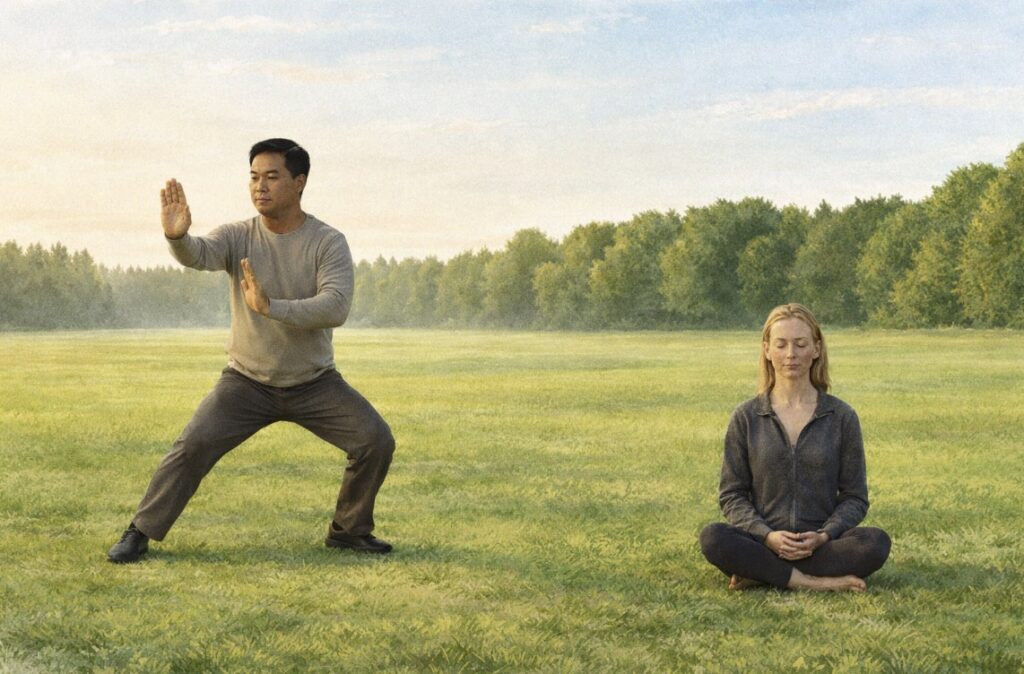
In tai chi qigong, movement and stillness are not opposites. Instead, they are two expressions of the same intention: to return to the body, the breath, and the present moment.
Similarly, donggong is meditation in motion — gentle shifts of weight, coordinated breath, and flowing awareness that guide chi through the body.
Likewise, jinggong is meditation in stillness — the body quiet, the breath soft, the mind settling into deeper listening.
For example, my master often reminded us that donggong is the easier beginning. After all, beginners struggle with stillness; fidgeting rises quickly. By contrast movement gives that restlessness a path, allowing the mind to settle without force.
In the end, both forms cultivate presence. Thus, each reveals what the other completes.
Two Doors, One Mind
To begin, donggong, the body becomes the anchor. Accordingly, movement steadies attention and gives the mind something to follow. Breath deepens naturally.
In jinggong, stillness becomes the teacher. With no movement to guide awareness, the inner landscape grows clearer. Sensations sharpen. Breath softens. The mind learns to rest without drifting.
Put simply, one trains presence in motion. The other trains presence in quiet. Together, they form a balanced practice that supports clarity and emotional steadiness.
How the Body Responds: Movement and Stillness in Practice
Overall, movement and stillness shape the body in different ways.
To illustrate, in donggong, gentle motion wakes the joints and fascia. Little by little, repetition unwinds tension. The nervous system settles through rhythm and breath.
In comparison, jinggong, the body becomes quiet enough for deeper signals to surface. In particular, two forms of awareness grow sharper:
-
- Proprioception is your sense of where your body is in space — knowing where your arms, legs, and spine are without looking.
- Interoception is your sense of what’s happening inside — your breath, heartbeat, temperature, and the subtle sensations that tell you when you’re tense or relaxed.
Consequently, stillness gives both room to speak.
Because of this, one mode releases what is stuck. In the meantime, the other refines what is subtle.
How Chi Moves: Flow and Stillness
To begin, in donggong, movement opens pathways. With each breath, posture creates a wave‑like flow. Chi circulates more freely, warming and loosening the body.
At the same time, in jinggong, chi gathers and settles. Without external motion, the internal currents become more noticeable — the soft pulsing, the quiet rising and falling.
In turn, flow nourishes stillness. At the same time, stillness clarifies flow. Together, they complete the circle.
Choosing the Right Practice for the Moment
In many cases, when the mind is restless, donggong offers a gentler entry. In these moments, movement steadies the breath and quiets fidgeting.
Conversely, when the body is tired or overstimulated, jinggong offers rest without collapse.
For this reason, for those living with chronic pain, the choice shifts day by day. Some days movement brings ease; other days stillness brings relief. Listening to your body is the practice.
Ultimately, there is no right or wrong — only what supports you in this moment.
A Personal Reflection
For me, I’ve always been the quiet, introverted type. As an adolescent I stumbled on a novel that mentioned meditation, and something in me recognized it. Eager to explore, I wanted to experience it for myself.
Later that night, after everyone had gone to sleep, I would sit cross‑legged on my bed and open my awareness to the night. With my eyes closed, the world became alive — leaves rustling, crickets singing, a distant car passing by. Stillness.
Years later, my master had me join his senior tai chi qigong group. I was an infant, both in years and maturity — the youngest among seasoned men with decades of experience. That was my first introduction to tai chi push hands and to jinggong meditation.
Even so, stillness came easily to me. However, I watched how difficult it was for most beginners. Their bodies fidgeted; their minds scattered. With this revelation I understood why my master always taught donggong first. Movement steadied what stillness could not yet hold.
In turn, that early experience shaped how I teach today — honoring both movement and quiet, and meeting people where they are.
Bringing Movement and Stillness Into Daily Life
In daily life, donggong can slip into ordinary moments. For example, slow your steps as you walk to the kitchen. Feel the weight shift from foot to foot. Let your breath guide a gentle sway as you stand at the sink.
Similarly, jinggong can happen in a single breath. Before rising from bed, pause. Feel the breath settle. Notice the warmth, the softness, the quiet inside.
In the same way, this balance mirrors how my master taught us: warm‑ups and qigong to open the body, tai chi movement to guide the flow, and sitting meditation to let peace settle around us.
This balance mirrors how my master taught us: warm‑ups and qigong to open the body, tai chi movement to guide the flow, and sitting meditation to let peace settle around us.
My e‑courses follow the same progression — movement preparing the body for stillness, and stillness deepening everything that came before.
Returning to Yourself, In Motion and In Stillness
In essence, movement and stillness are two ways of coming home. Whether you enter through donggong or jinggong, both lead toward clarity, balance, and a steadier way of being.
Moving forward, stay connected for the next post in this series, where we’ll explore the different meditation postures — standing, sitting, and recumbent — and how each one supports awareness in its own way.
Finally, if you’d like to experience these practices directly, my e‑courses can guide you through both movement and stillness so you can feel the benefits for yourself — one breath, one movement at a time.

You might be interested in:
- Mindfulness & Meditation — Post 1 Mindfulness & Chi Through Tai Chi Qigong Meditation
- Mindfulness & Meditation — Post 2 Physical Benefits of Tai Chi Qigong Mindful Meditation
- Mindfulness & Meditation — Post 3 Mental and Emotional Benefits of Tai Chi Qigong Meditation
- Mindfulness & Meditation — Post 4 Cognitive Benefits of Tai Chi Qigong Mindful Meditation
- Mindfulness & Meditation — Post 5 Benefits of Energy Regulation and Breath in Tai Chi Qigong
- Mindfulness & Meditation — Post 6 Spiritual Growth Through Tai Chi Qigong Meditation
- Mindfulness & Meditation — Post 7 How Internal Listening Builds Sensory Awareness
- Mindfulness & Meditation — Post 8 Everyday Mindful Movement with Tai Chi Qigong
- Mindfulness & Meditation — Post 10 Tai Chi Qigong Postures for Mindful Meditation
- Mindfulness & Meditation — Post 11 Tai Chi Qigong Mindful Meditation for Every Body
- Mindfulness & Meditation — Post 12 Tai Chi Qigong Tools for Mindful Meditation
- Mindfulness & Meditation — Post 13 Yi, Wuwei, & Wuji in Tai Chi Qigong Mindful Meditation