Mindfulness & Meditation — Post 6
Holistic and spiritual benefits of tai chi qigong meditation: how to support growth through grounding, mind‑body‑spirit integration, and inner peace.
Over the past few posts in this tai chi qigong meditation series, we have been building a clear foundation. We began with the distinction between meditation and mindfulness. Then we explored the physical benefits of meditation. Most recently, we looked at the mental and emotional shifts that unfold through steady practice.
Each layer has shown how accessible and transformative these practices can be. Especially when approached through the gentle, sustainable lens of tai chi qigong, they become even more supportive.
This next step in the series moves us into a deeper dimension. Often, people feel this shift long before they can fully articulate it.
Beyond the muscles, breath, and emotional steadiness lies something more expansive. It is the holistic and spiritual connection that emerges when body, mind, and spirit begin to move in harmony.
In my own practice, this part often reveals itself quietly and almost unexpectedly. Over time, it becomes the most grounding and sustaining aspect of the journey.
In this post, we explore how tai chi qigong meditation supports mind‑body‑spirit integration. We also look at grounding, centering, and the cultivation of inner peace. Importantly, this peace does not depend on external circumstances.
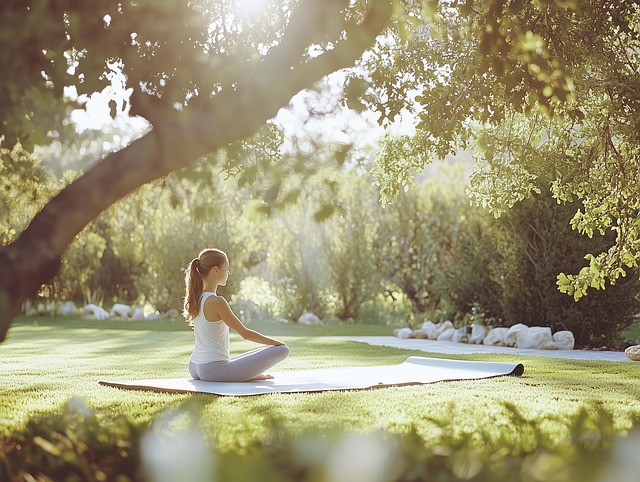
Mind‑Body‑Spirit Integration
One profound aspect of tai chi qigong meditation is its ability to weave together the physical, mental, and spiritual layers of your experience. Even if someone begins the practice for just simple stress relief or gentle movement, they often discover so much more.
Sometimes quietly, sometimes unmistakably, they realize the practice is working on multiple levels at once.
At its core, tai chi qigong rests on one understanding. Your body, mind, and spirit are not separate systems. Instead, they are interconnected expressions of the same life force, or Chi. When your breath slows, your posture softens, and your awareness settles, these three aspects begin to communicate again. Instead of pulling in different directions, they start to move as one.
This integration isn’t dramatic or mystical; it’s steady, lived, and deeply practical. You may notice it in the way your body feels more responsive. Your thoughts may feel less scattered. Gradually, your inner landscape becomes more spacious.
In my own practice, this often shows up as a quiet sense of coherence. It feels like all the parts of me finally sitting at the same table and listening to the same conversation.
Over time, this mind‑body‑spirit harmony becomes a kind of internal alignment. No matter what is happening around you, you can return to it. It’s one of the reasons tai chi qigong meditation becomes not just a technique, but a way of being.
Personal Reflection: A Spiritual Test in Practice
In the senior class, my master often reminded us that spiritual development unfolds like physical training. It progresses step by step and level by level.
He taught that every person, at some point, will face a spiritual test. The timing is never announced, and the subject is never the same.
If we fail, the test returns, offering us another chance to see our weaknesses clearly and learn from them. This, he said, is how we progress in our spiritual education and move toward higher levels of maturity and self‑realization.
For a long time, I wondered what my own test would be. Was it material attachment? I didn’t think so. Money, to me, was simply a means to meet needs. I also knew none of it would follow us when we leave this material world.
Was it love? I cherished my family deeply, but my Christian faith gave me confidence that they were always in God’s hands. We had our ups and downs, but we were blessed with love, family, and close friends.
So what, then, would challenge me at the deepest level?
The answer came unexpectedly during a period of deep meditation.
A Moment of Spiritual Epiphany
As my breath settled and my awareness expanded, I felt myself transcend the physical world. Suddenly, the entire universe appeared before me. Stars stretched into infinity. The Earth looked like a small, delicate sphere suspended in space.
In that moment, an extraordinary temptation arose: the offer of power beyond anything I had ever imagined. Power over Earth. Power to conquer. Power to control. It was exhilarating, intoxicating, and completely unexpected.
But then something within me shifted.
A quiet clarity surfaced: This is not the purpose of meditation.
I felt myself pull back, returning to the principle of wuwei — non‑action, letting things be. I released the temptation, emptied the mind again, and the entire vision dissolved. When I returned to the present moment, I realized I had just faced — and passed — my first spiritual test.
My master’s sister once shared her own experience with me. Her test was one of sexual temptation. She failed the first time, then encountered it again later and passed.
Her story, like mine, reinforced what my master had always taught: everyone faces these tests. Passing or failing is not the point. What matters is what we learn, how we grow, and how each test moves us forward toward greater spiritual maturity.
Grounding & Centering
One of the first subtle shifts people notice in tai chi qigong meditation is a growing sense of groundedness. It becomes an inner steadiness that does not depend on perfect circumstances.
The slow, intentional movements and gentle breathwork help you reconnect with your body. They create a feeling that is stabilizing rather than effortful.
Instead of being pulled upward into tension or scattered thoughts, your awareness begins to settle downward. Gradually, it moves toward a place of rooted presence.
This grounding is more than a physical sensation. It’s a recalibration of your internal landscape.
As your breath deepens and your chi circulates more smoothly, your nervous system begins to soften its grip. You feel more anchored, more capable of meeting your day without being swept away by it.
Many practitioners describe this as “coming home” to themselves. It feels like a return to a state where clarity and calm are accessible again.
Centering naturally follows. When your body feels rooted, your mind has space to settle. The practice becomes a way of gathering yourself. It draws your attention back from the noise of the world. Eventually, it leads you into the quiet center where your intuition, resilience, and inner wisdom live.
In my own practice, this centering often shows up as a gentle shift. It feels like the moment when a snow globe finally stops swirling and everything becomes clear again.
Over time, grounding and centering become qualities you carry with you, not just experiences you have during practice. They form the foundation for the deeper spiritual connection that tai chi qigong meditation makes possible.
Cultivating Inner Peace
As your tai chi qigong meditation practice deepens, something subtle but unmistakable begins to unfold. You begin to feel a sense of inner peace that does not rely on life being calm or predictable.
Instead of chasing stillness, you start to generate it from within. The breath slows, the mind softens, and the circulation of chi becomes smoother and more harmonious. What once felt like effort gradually becomes a natural state of being.
This inner peace isn’t about escaping the world or ignoring challenges. It’s about developing the capacity to meet life with steadiness rather than reactivity.
When your nervous system learns to settle, your thoughts become clearer, your emotions more balanced, and your spirit more spacious. Even on difficult days, you may find yourself returning to a quiet center that feels steady and trustworthy.
In my own practice, this often shows up in small, unexpected moments. I may notice I am responding to stress with more clarity. Or I may notice my breath deepening when life becomes overwhelming. These moments accumulate, and over time, they form a kind of inner refuge you can access anytime, anywhere.
Cultivating inner peace through tai chi qigong meditation isn’t a destination; it’s a relationship you build with yourself. The more consistently you practice, the more this peace becomes woven into your daily life.
Continuing the Journey
The spiritual dimensions of tai chi qigong meditation remind us that growth is not linear and awakening is not accidental. It rarely arrives with fanfare.
On the contrary, it unfolds quietly and in the same rhythm as the practice itself. It grows through breath, awareness, and the willingness to meet whatever arises with honesty. The grounding, the inner peace, the moments of clarity, and even the spiritual tests all become part of a single unfolding. Together, they form one continuous journey.
In the next post, we will look at the practical benefits of tai chi qigong meditation. We will explore how this practice can support your daily life while your inner work continues.
If you feel called to deepen your journey, I invite you to join my e‑courses. We move through this work gently and steadily, One Breath, One Movement at a Time.
You might be interested in:
- Mindfulness & Meditation — Post 1 Mindfulness & Chi Through Tai Chi Qigong Meditation
- Mindfulness & Meditation — Post 2 Physical Benefits of Tai Chi Qigong Mindful Meditation
- Mindfulness & Meditation — Post 3 Mental and Emotional Benefits of Tai Chi Qigong Meditation
- Mindfulness & Meditation — Post 4 Cognitive Benefits of Tai Chi Qigong Mindful Meditation
- Mindfulness & Meditation — Post 5 Benefits of Energy Regulation and Breath in Tai Chi Qigong
- Mindfulness & Meditation — Post 7 How Internal Listening Builds Sensory Awareness
- Mindfulness & Meditation — Post 8 Everyday Mindful Movement with Tai Chi Qigong
- Mindfulness & Meditation — Post 9 Moving vs. Quiescent Meditation in Tai Chi Qigong
- Mindfulness & Meditation — Post 10 Tai Chi Qigong Postures for Mindful Meditation
- Mindfulness & Meditation — Post 11 Tai Chi Qigong Mindful Meditation for Every Body
- Mindfulness & Meditation — Post 12 Tai Chi Qigong Tools for Mindful Meditation
- Mindfulness & Meditation — Post 13 Yi, Wuwei, & Wuji in Tai Chi Qigong Mindful Meditation