Mental & Emotional Benefits of Chi — Post 1
Cultivate chi to build emotional resilience and reduce distress — tai chi qigong’s mindful movement and breath restore calm, clarity, and inner strength.
In a previous blog series, I explored the physical health benefits of cultivating chi through tai chi qigong. What is significant is that this ancient practice enhances flexibility, strengthens the body, and supports overall vitality.
Now, I’d like to shift our focus to the equally crucial mental and emotional benefits. Tai chi qigong empowers us to navigate stress, build deep resilience, and cultivate profound inner harmony.
Unfortunately, in today’s fast‑paced world, stress isn’t just an occasional inconvenience. It is a pervasive force that often leaves us feeling drained, overwhelmed, and perpetually reactive. Too often, we find ourselves caught in a cycle of anxiety, struggling to maintain a sense of calm amidst chaos.
But what if the key to profound inner peace and emotional balance was already within us? Of importance, what if it were accessible through a practice that harmonizes mind and body?
Through the disciplined yet fluid movements of tai chi qigong, we learn to harness the power of chi, our innate lifeforce energy. This restores equilibrium, cultivates resilience, and helps us navigate life’s challenges with grace and grounded presence.
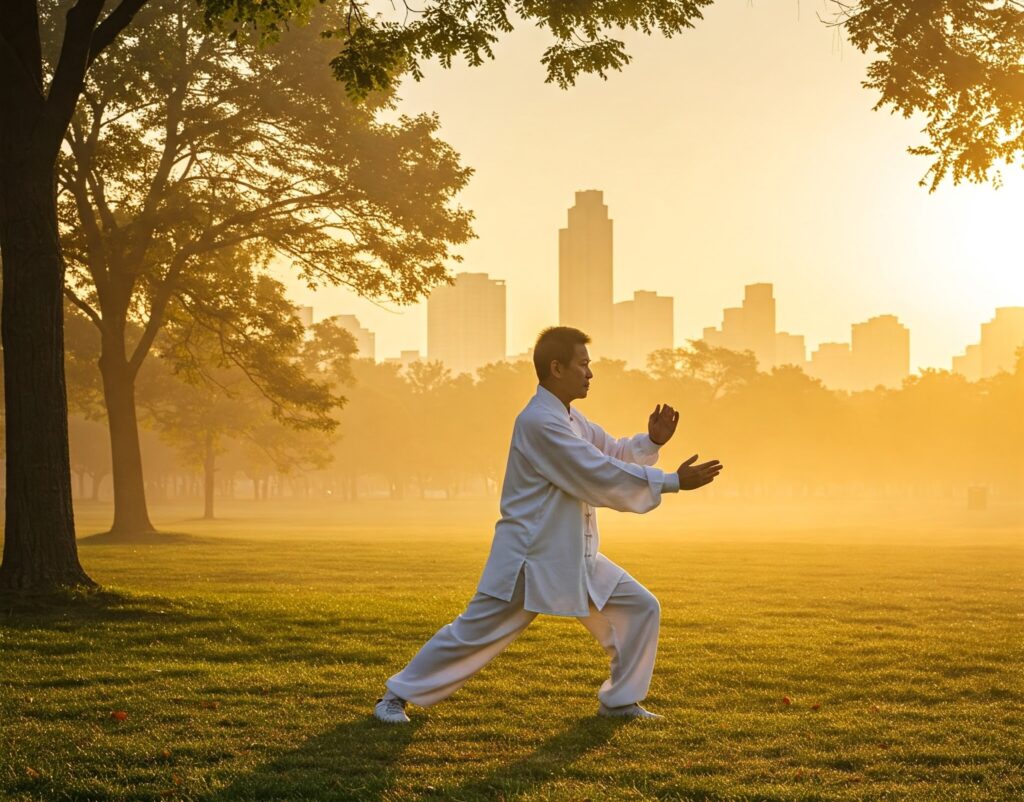
The Science Behind Chi and Emotional Resilience
Increasingly, modern research confirms tai chi qigong significantly enhances emotional regulation and stress resilience by influencing our nervous system and brain chemistry. Its slow, deliberate movements and deep breathing actively engage the parasympathetic nervous system, the body’s ‘rest and digest’ system.
This engagement directly counteracts the stress response. Specifically, it lowers cortisol levels, the primary stress hormone, and promotes profound calm and mental clarity.
What’s more, groundbreaking research highlights how postural alignment and mindful, intentional movement in tai chi qigong shape mood and emotional well‑being. These findings emphasize the deep connection between our physical state and emotional landscape.
Of particular note, neuroscientists find that these practices, especially deep rhythmic breathing, stimulate the vagus nerve. This vital nerve connects the brain to crucial organs and regulates heart rate, digestion, and emotional state. By toning the vagus nerve, tai chi qigong invariably reduces anxiety and enhances emotional stability.
Hence, consistent practice does more than manage stress. It can definitively rewire how we experience it, shifting us from impulsive reactivity to thoughtful, resilient response.
Research Highlights: Scientific Validation of Mind-Body Harmony
Several scientific studies affirm the mental and emotional benefits of tai chi qigong:
- Systematic Review & Meta-Analysis (Frontiers in Psychology, 2020): This comprehensive systematic review analyzed 33 randomized controlled trials, revealing that tai chi qigong significantly reduces symptoms of both anxiety (SMD = 0.386) and depression (SMD = 1.937). Critically, the study also found that consistent practice lowers cortisol levels (SMD = 0.621), a key stress hormone, underscoring its direct physiological impact on stress reduction (Zhang et al., 2020). This shows the practice directly targets the body’s stress response, promoting internal balance.
- Tai Chi Qigong for Anxiety & Depression (The Massachusetts General Hospital Guide to Depression, 2019): This influential study highlights tai chi qigong’s immense value as a self-healing exercise. It specifically details how its meditative movement techniques actively improve mood, foster emotional balance, and significantly enhance stress management capabilities (Wang et al., 2019). Thus, this research positions tai chi qigong as an accessible and effective tool for proactive emotional well-being.
- Tai Chi’s Impact on Emotional Regulation (Journal of Psychosomatic Research, 2021): Notably, researchers in this study discovered that tai chi qigong profoundly activates the parasympathetic nervous system, leading to a significant reduction in physiological stress markers. Beyond this, the practice was found to increase self-awareness and enhance emotional regulation (Liu et al., 2021). This suggests, therefore, tai chi qigong not only calms the body but also strengthens our capacity to skillfully manage our emotional landscape.
Ancient Wisdom: The Role of Chi and Shen
Beyond modern science, tai chi qigong’s benefits stem from Traditional Chinese Medicine (TCM). TCM also teaches that chi—our fundamental intrinsic energy—flows through meridians, influencing physical and emotional balance.
When chi is blocked or stagnant, it can cause emotional turmoil like stress, anxiety, and irritability. Tai chi qigong gently unblocks and harmonizes this energy, bringing profound inner calm, clarity, and emotional stability.
Beyond chi, ancient wisdom highlights Shen, the spirit that represents mental clarity and emotional harmony. Nurtured by tai chi qigong’s tranquil movements, Shen blossoms and fosters deep inner peace, enhanced intuition, and resilience. Cultivating balanced chi and luminous Shen unlocks the practice’s emotional benefits.
Strengthening Emotional Resilience—One Breath, One Movement at a Time
Resilience isn’t avoiding difficulties. It is learning to stand strong, adaptable, and centered in adversity. Equally important, it includes the capacity to bounce back, learn from setbacks, and maintain inner equilibrium.
Moreover, consistent tai chi qigong practice enhances self‑awareness, emotional regulation, and mental clarity. You gain the ability to recognize stress as it arises and observe emotional responses without judgment. You also learn to shift from knee‑jerk reaction to thoughtful reflection.
Additionally, this shift allows you to handle stress with greater grace, approach life from a centered state, and thrive amidst life’s ebb and flow.
Reflection: How Do You Manage Stress?
Let’s take a moment to pause and consider your own relationship with stress and emotional well-being. Tai chi qigong offers a powerful path, but understanding your starting point is key to embarking on this journey.
- How do you currently manage stress? Consider the strategies you instinctively turn to, both helpful and unhelpful. What are their immediate and long-term effects on your energy and mood?
- What would it feel like to cultivate deep emotional balance? Close your eyes for a moment and envision a state where stress doesn’t overwhelm you, where you can respond calmly to challenges. What does that inner peace look like, and how might it transform your daily life?
- How might Tai Chi Qigong help you navigate life’s challenges with greater ease? Based on what you’ve read, how do you see this practice specifically supporting your personal journey toward resilience and inner harmony?
Experience the Transformation: Your Journey to Inner Harmony
The journey to emotional resilience and inner peace begins with a single mindful breath. If you’re ready to explore the transformative power of tai chi qigong, stay connected. Visit my website often for new insights, practical tips, and updates on upcoming blogs.
Even better, you can also sign up for my e‑courses when they become available. These courses guide you step by step toward greater balance, vitality, and emotional strength. Experience for yourself the incredible benefits of tai chi qigong, one breath, one movement at a time.
You might be interested in:
- Mental & Emotional Benefits of Chi — Post 2 Sharpen Mental Clarity & Focus Naturally with Tai Chi Qigong
- Mental & Emotional Benefits of Chi — Post 3 Tai Chi Qigong: Cultivate Chi for Inner Peace & Balance
- Mental & Emotional Benefits of Chi — Post 4 Tai Chi Qigong for Increased Confidence & Inner Power
- Mental & Emotional Benefits of Chi — Post 5 Nurture Chi with Tai Chi Qigong for Creativity & Intuition
- Mental & Emotional Benefits of Chi — Post 6 Cultivating Chi for Emotional Healing with Tai Chi Qigong
- Mental & Emotional Benefits of Chi — Post 7 Cultivate Self-Awareness & Empathy Via Tai Chi Qigong & Chi
Citations
Systematic Review & Meta-Analysis on Psychological Benefits Zhang, D., Liu, X., Li, R., Cui, J., Liu, F., Smith, L., & Chen, X. (2021). The Effects of Tai Chi and Qigong Exercise on Psychological Status in Adolescents: A Systematic Review and Meta-Analysis. Frontiers in Psychology, 12, 746975. DOI: 10.3389/fpsyg.2021.746975.
Tai Chi & Qigong for Anxiety & Depression Yeung, A., Chan, J. S. M., Cheung, J. C., & Zou, L. (2018). Qigong and Tai-Chi for Mood Regulation. Focus, 16(1), 40–47. DOI: 10.1176/appi.focus.20170042.
The Science Behind Tai Chi & Emotional Resilience Osypiuk, K., Thompson, E., & Wayne, P. M. (2018). Can Tai Chi and Qigong Postures Shape Our Mood? Toward an Embodied Cognition Framework for Mind-Body Research. Frontiers in Human Neuroscience, 12, 174. DOI: 10.3389/fnhum.2018.00174.