Internal martial arts (Neigong) originated from Bodhidharma’s classic, the Yi Jin Jing (Muscle-Tendon Changing Classic). This development marked the third major phase in the long evolution of qigong.
In contrast to waigong (external martial arts), which focuses on physical conditioning, neigong integrates breathing and meditation techniques. Consequently, practitioners use these qigong practices to cultivate chi (vital energy) and build significant internal strength.
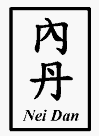
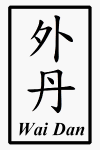
Furthermore, qigong nurtures two specific forms of energy: nei dan (internal elixir) and wai dan (external elixir). While nei dan refers to the refinement of internal energy, wai dan relates to energy that is external, localized, or surface-level.
From 502 AD to 1911 AD, spanning the Liang Dynasty through to the fall of the Qing Dynasty, qigong’s primary focus shifted toward developing internal arts.
The Rise of Qigong Martial Arts
During this period, Buddhism was in decline. However, the discovery that qigong could enhance martial arts ushered in a new era—the age of Martial Arts Qigong.
In 527 AD, Emperor Liang Wu Di, a devoted patron of Buddhism, invited an Indian Buddhist monk to his royal court. That monk was Bodhidharma, known in China as Da Mo. According to legend, Da Mo’s terse and deeply philosophical views frustrated the emperor. Consequently, the monk departed and traveled to the Shaolin Temple in Luoyang.
Upon his arrival, Da Mo found the resident monks weak and in poor health. Seeking a solution, he meditated in a cave for nine years. As a result of this long isolation, he developed two primary neigong classics to strengthen the monks: the Yi Jin Jing (Muscle-Tendon Changing Classic) and the Xi Sui Jing (Marrow/Brain Washing Classic).
Furthermore, these practices taught the monks how to use chi to transform their bodies from frail to formidable. Eventually, the Shaolin monks became famous throughout China for their incredible strength and martial prowess.
The Philosophy Behind Shaolin Martial Arts
Historically, the monks viewed their physical bodies as the “vessel” for their spiritual journey. However, before Da Mo introduced his techniques, the monks focused almost exclusively on meditation and neglected their physical health. Consequently, they lacked the stamina required for deep spiritual work.
By introducing his methods, Da Mo taught the monks that a strong body supports a strong mind. In this way, martial arts became a form of “moving meditation.” Furthermore, the monks understood that while their strength allowed them to protect the temple, this was only a secondary benefit to their spiritual growth. Their true philosophy focused on non-violence, as encapsulated in the original Chinese:
「不動手則不犯」 (“Bu dong shou ze bu fan” — One who engages in combat has already lost the battle.)
The Essence of Yi Jin Jing
The Yi Jin Jing exercises belong to wai dan (external chi cultivation) qigong. Specifically, they use yi (focused intent) and visualization to direct local chi, enhancing its circulation throughout the body.
Over time, these exercises evolved into Luohan Shi-Ba Zhang (Eighteen Priest-Scholar Palms), forming the foundation of Chinese temple boxing and Shaolin martial arts.
In Chinese medicine, tendons symbolize meridians—pathways for energy flow—while marrow represents the heart. Thus, the Yi Jin Jing is about “transforming tendons”—opening energy channels, removing blockages, and restoring natural chi flow to promote health.
With regular practice, Yi Jin Jing not only sustains well-being but also fortifies immunity against disease and age-related deterioration.
Ultimately, this is the origin of Da Mo Qigong. While people still practice it today, the system has evolved into a set of exercises focused on health maintenance, chronic illness treatment, and its original goal of meditation and enlightenment.
This is the origin of Da Mo Qigong. While still practiced today, it has evolved into a set of exercises focused on health maintenance, chronic illness treatment, and its original goal of meditation and enlightenment.
Ramifications of the Two Martial Arts Classics
Of the two martial arts classics written by Bodhidharma, only the Yi Jin Jing has survived. The Xi Sui Jing (Marrow-Washing Classic) taught Buddhist monks how to use chi to purify the bone marrow, strengthen the blood, heart, and immune system, and prepare for Buddhahood.
However, because it was difficult to understand and even harder to train, only the most advanced disciples could practice the Xi Sui Jing. For others—especially laypeople—it remained a secret, passed down to only a privileged few.
In fact, Bodhidharma’s teaching philosophy justified this exclusivity:
「教外別傳,不立文字,直指人心,見性成佛。」 (Jiao wai bie chuan, bu li wen zi, zhi bie ren xin, jian xing cheng fo.)
Translation: “Do not transmit [these teachings] to outsiders of our sect. Words should not be recorded in writing. Point directly to a person’s heart. See and cultivate the person into a Buddha.”
In other words, only true Shaolin Buddhists could access this knowledge. Furthermore, Bodhidharma believed teachings should not be written down for outsiders, but rather passed on through personal insight—judging an individual’s mind and guiding those who were truly devoted toward enlightenment.
Notably, Bodhidharma’s two classics were deeply rooted in Chan Zong (Chan Buddhism), which later evolved into Zen Buddhism in Japan. The Yi Jin Jing and Xi Sui Jing were intended to be practiced together as a complete system leading toward Buddhahood. However, when separated, practitioners could not achieve the final purpose.
Yet, paradoxically, modern Chan Buddhism lacks Yi Jin Jing training, and the Shaolin Temple rarely teaches Xi Sui Jing.
The Lost Legacy of Xi Sui Jing
According to history, Bodhidharma entrusted the Xi Sui Jing techniques to his top disciple, Hui Ke, before his death. However, over generations, the knowledge was lost—perhaps because the practitioners kept it too secret.
Fortunately, Taoists preserved many of Bodhidharma’s teachings—including the Yi Jin Jing. They safeguarded Buddhist knowledge alongside their own practices. This cross-cultural exchange is reflected in the saying:
「佛道一家」 (Fo Dao Yi Jia) “Buddhism and Taoism are one family.”
In the early days of religious Taoism, the philosophy drew from both Taoist traditions and Buddhist teachings, leading to significant overlap between the two. Notably, even before Bodhidharma arrived at the Shaolin Temple, Taoists had already adapted many Buddhist qigong practices. As a result, even after his death, they retained a vast collection of Buddhist manuals and martial arts techniques, including the Yi Jin Jing.
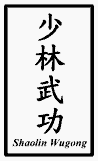
Following Bodhidharma’s era, Shaolin monks continued to develop Wai Dan Martial Arts. They created forms inspired by aggressive animals—styles still practiced in wugong today:
🐅 Tiger (power)
🐆 Leopard (speed)
🐉 Dragon (spirit)
🐍 Snake (flexibility)
🦅 Crane (balance)
Ultimately, these traditions endure and form the foundation of modern Shaolin martial arts. They preserve the legacy of neigong, qigong, and the ancient wisdom of Bodhidharma.